Cowbells drift across the ridge while the Eiger holds still against the sky.
Lauberhorn
A finish line built into rock, where speed became a tradition.
The Lauberhorn rises above Wengen in the Bernese Oberland, its summit at 2,472 metres facing the Eiger, Mönch and Jungfrau across the valley. Since 1930 it has carried the world's longest World Cup downhill course, 4.48 kilometres from the start house to Innerwengen, dropping 1,028 metres along the way. Racers reach 160 km/h on the Haneggschuss before the course narrows at the Hundschopf, a jump cut into a rock outcrop that has decided more than one championship.
What sets the Lauberhorn apart is that the course stays open. In summer, walkers follow the same line the racers take, past the Hundschopf and the other named passages, with eight viewpoints explaining what each spot demands at speed.
The Lauberhornrennen still draws around 30,000 spectators each January, the week before Kitzbühel's Hahnenkamm. For the rest of the year, the mountain empties out, and the view of the three peaks is left to whoever walks up to see it.
More in Wengen
This restaurant is a request stop on the Wengernalpbahn, where the train pauses only if someone raises a hand.
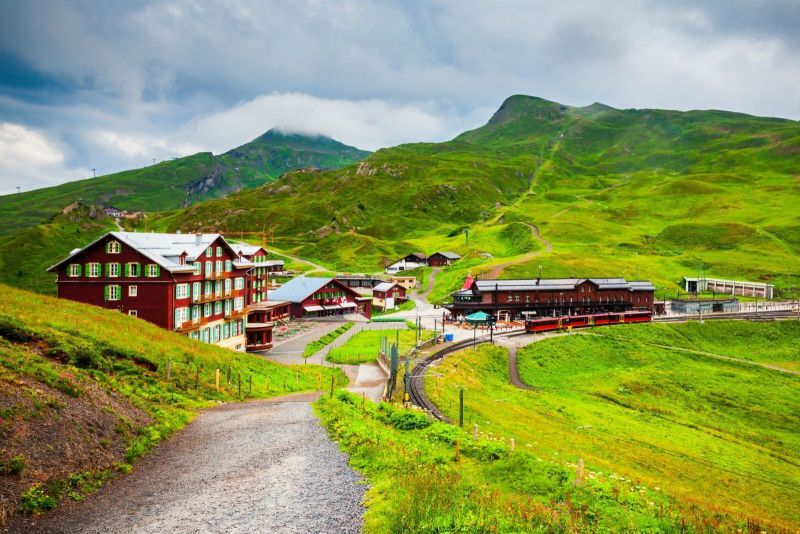
Two railways climb from opposite valleys and meet at 2,061 metres, under a wall of rock and ice.
The path ends at a railing, and after that there is only air.