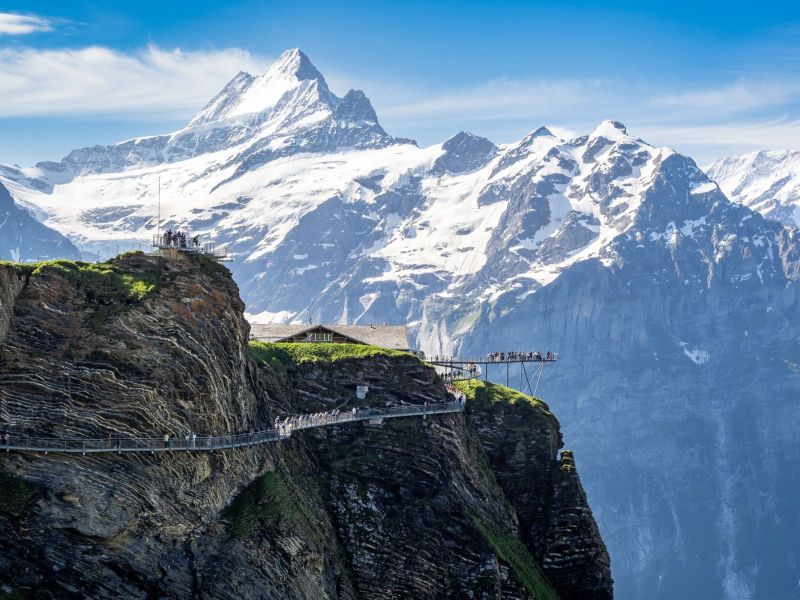
A steel walkway ends in open air, forty-five metres above the valley.
Bern region Grindelwald
Grindelwald
Plan
Plan your trip
A handcrafted itinerary for Grindelwald.
SleepFind your stay
A short, curated list. None of them a chain.
GuidesFollow a route
Hand-curated, walked before written.
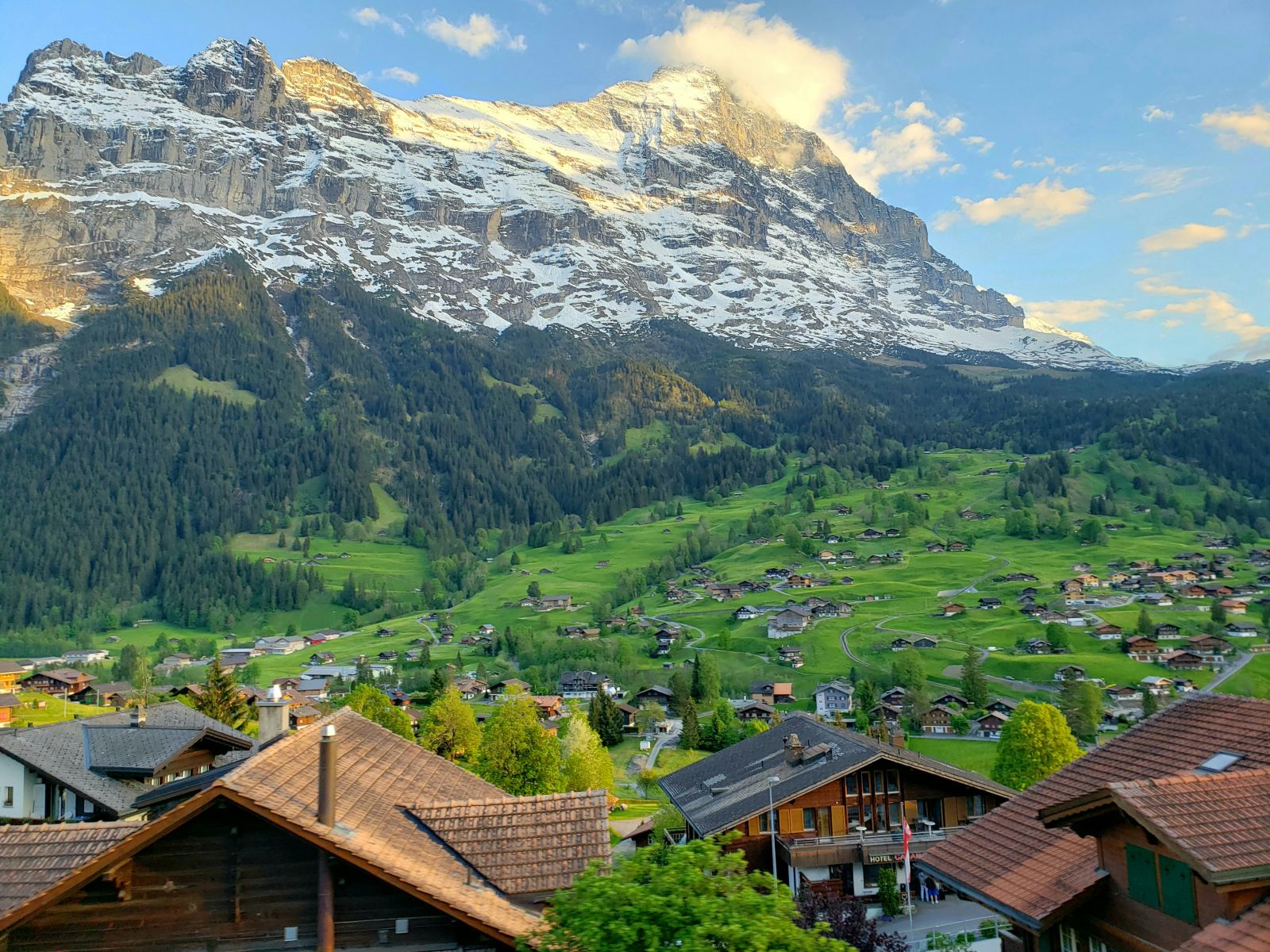
Grindelwald sits at 1,034 metres in the Bernese Oberland, thirty-five minutes by train from Interlaken Ost.
The village stretches west to east along the valley floor, wooden chalets facing the Wetterhorn and the north face of the Eiger, a wall of rock and ice that rises 3,970 metres directly above the rooftops. 3,800 people live here year-round, a number that multiplies many times over in high season.
The Berner Oberland-Bahnen line ends at the station on Dorfstrasse, opened in 1890, and from Grindelwald Terminal the Eiger Express gondola climbs toward Jungfraujoch, the highest railway station in Europe.
First, at 2,166 metres, rises on the opposite side of the valley, reachable by cable car in twenty-five minutes. Grosse Scheidegg, the old pass toward Meiringen, closes to private cars but stays open to the yellow postbus.
Things worth slowing down for
A few of our favourite spots in Grindelwald.
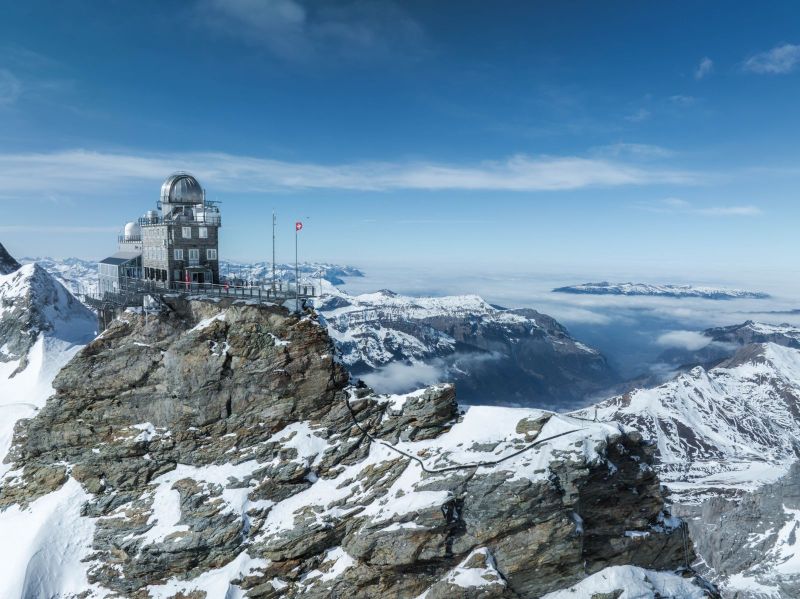
At the Top of Europe: A mighty glacier, permanent snow and, on clear days, France.
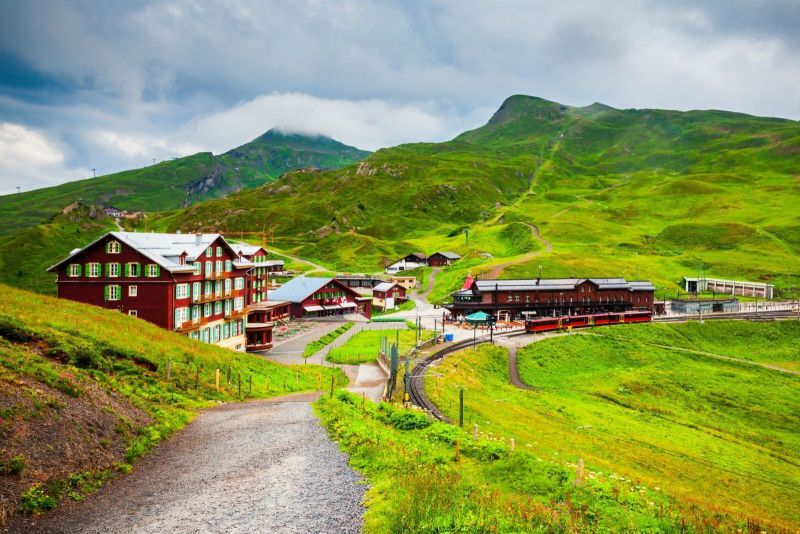
Two railways climb from opposite valleys and meet at 2,061 metres, under a wall of rock and ice.

A lake that holds the Wetterhorn twice: once in the sky, once on its surface.
Cowbells drift across the ridge while the Eiger holds still against the sky.
A ridge where two valleys divide, ice fields close enough to study.
What makes Grindelwald slow travel perfect
Grindelwald is a village built around a mountain that dominates every view from it. The Eiger does not announce itself gradually the way distant peaks do elsewhere in Switzerland. It is simply there, above the church spire, above the hotel terraces, above whichever direction someone happens to be walking. Climbers have died on that north face since the first serious attempts in the 1930s, and the village has never distanced itself from that history.
Grindelwald built a name from proximity to danger, then found a second identity in comfort: wellness hotels, cheese dairies, a Thursday farmers' market on Dorfstrasse.
What separates a visit here from a rushed Eiger photo stop is the hike to Bachalpsee, two hours above First, where the Alps show up twice, once in rock and once reflected in still water. Or the early gondola to Männlichen, six kilometres and nearly ten minutes long, opened in 1978 as the longest passenger cableway in the world at the time, now mostly used by walkers heading the ridge trail toward Kleine Scheidegg with the Jungfrau, Mönch and Eiger lined up on one side the entire way. Grosse Scheidegg rewards those willing to take the postbus rather than the cable car, a pass road with no equivalent view sold in a gift shop.
Winter turns the same terrain into ski runs and the Pintenfritz toboggan run, one of the longest in Europe. Summer or winter, the geography stays fixed: a valley floor at just over a thousand metres, glaciers retreating slowly at its edges, and a wall of limestone and ice that has watched the village grow up beneath it for centuries.